The payoff: a full ad-click flow
This is where it goes: one controller, eight hubs, one log per click. The hubs are the stages of a real click flow: validation and a session, tracking, geo exclusions, the advertiser's suppression list (skipped for newsletter-type campaigns), blacklists and graylists, bot checks (skipped when a campaign turns them off), caps and budget, and routing.
The subject is IncomingClick, a class of your own built from the request. It has fields (id, campaign, country, ip, userAgent, publisher, email) and a few methods the flow calls through the envelope: campaignSettings() (the campaign's countries, type and bot-check switch), flag($reason) / isFlagged(), isListed(), isTest(), markComplete() and destination().
<?php

use Illuminate\Http\Request;
use Keaton\PipeDream\Exceptions\PipeRuleLoadView;
use Keaton\PipeDream\Exceptions\PipeRuleRedirect;
use Keaton\PipeDream\PipeEnvelope;
use Keaton\PipeDream\PipeHub;
use Keaton\PipeDream\PipeManager;
use Keaton\PipeDream\Strategies\DatabasePersistStrategy;

class HandleAdClick
{
    public function __invoke(Request $request)
    {
        $click = PipeEnvelope::wrap(new IncomingClick($request))
            ->persistWith(new DatabasePersistStrategy());

        $started = microtime(true);

        try {
            PipeManager::create([

                PipeHub::create()
                    ->name('Validate & start session')
                    ->description('Is this a complete, signed click for a live campaign?')
                    ->addPipes([
                        RequireTrackingParameters::class,
                        VerifyClickSignature::class,
                        RecognizeCampaign::class,
                        StartClickSession::class,
                    ]),                          // a fatal here (a bad click) ends the whole flow

                PipeHub::create()
                    ->name('Tracking')
                    ->description('Attribution cookie and conversion-path tracking')
                    ->addPipes([
                        SetAttributionCookie::class,
                        RecordConversionPath::class,
                    ]),

                PipeHub::create()
                    ->name('Geo exclusions')
                    ->description('Is the visitor somewhere this campaign buys traffic?')
                    ->addPipes([
                        ResolveVisitorCountry::class,
                        EnforceCampaignCountries::class,
                        EnforceAdvertiserGeoExclusions::class,
                    ]),

                PipeHub::create()
                    ->name('Suppression')
                    ->description('Has this visitor asked the advertiser not to contact them?')
                    ->addPipes([
                        CheckAdvertiserSuppressionList::class,
                    ])
                    ->skipIf(fn ($click) => $click->campaignSettings()->isNewsletter()),

                PipeHub::create()
                    ->name('Blacklist & graylist')
                    ->description('Checks that are never skipped')
                    ->addPipes([
                        MatchIpBlacklist::class,
                        MatchPublisherBlacklist::class,
                        ChallengeGraylistedPublishers::class,
                    ])
                    ->then(fn ($click) => $click->isListed() ? $click->flag('Blacklisted') : null),

                PipeHub::create()
                    ->name('Bot checks')
                    ->description('Does this look like a person, not a script or a server?')
                    ->addPipes([
                        DetectHostingProviderIp::class,
                        MatchKnownBotUserAgents::class,
                        ScoreClickVelocity::class,
                    ])
                    ->skipIf(fn ($click) => $click->campaignSettings()->bot_checks_disabled)
                    ->then(fn ($click) => $click->get('bot_signals') >= 2 ? $click->flag('Two or more bot signals') : null),

                PipeHub::create()
                    ->name('Fulfillment & caps')
                    ->description('Daily caps and budget, only for clicks we will pay for')
                    ->addPipes([
                        EnforceDailyClickCap::class,
                        RecordBudgetSpend::class,
                    ])
                    ->skipIf(fn ($click) => $click->isFlagged() || $click->isTest())
                    ->errorsAreFatal()           // a failed charge ends this hub...
                    ->fatalsStopThisHubOnly(),   // ...but the click is still routed

                PipeHub::create()
                    ->name('Route')
                    ->description('Landing page, review queue or a safe dead end')
                    ->addPipes([
                        ChooseDestination::class,
                    ]),

            ])
                ->name('Ad click intake')
                ->subject($click)
                ->persistLogs(false)             // we persist once, below, after the timer
                ->then(fn ($click) => $click->markComplete())
                ->sendIt();

        } catch (PipeRuleRedirect $e) {
            return redirect()->to($e->redirectTo);
        } catch (PipeRuleLoadView $e) {
            return view($e->view, $e->data);
        } finally {
            $click->logger()->info('Intake', sprintf('Handled in %.1f ms', (microtime(true) - $started) * 1000));
            $click->persist();                   // one row per click, whatever happened
        }

        return redirect()->to($click->destination());
    }
}
A fatal in any hub ends the click's flow, except in Fulfillment & caps: there errorsAreFatal() turns a failed charge into a fatal, and fatalsStopThisHubOnly() contains it to that hub, so the click is still routed.
The controller saves the log once, in finally, after recording how long the click took (->persistLogs(false) stops the manager saving it first), so every click gets exactly one row, including the ones that end early or hand off to a view.
All of these rules are in docs/examples/. Some have real bodies (CheckAdvertiserSuppressionList, ChallengeGraylistedPublishers, DetectHostingProviderIp, MatchKnownBotUserAgents, RecordBudgetSpend, and the small ones the tests rely on: RequireTrackingParameters, RecognizeCampaign, StartClickSession, ResolveVisitorCountry, EnforceCampaignCountries, MatchIpBlacklist, ChooseDestination); the rest are placeholders that only return SUCCESS, named for what your own rule would do (VerifyClickSignature, SetAttributionCookie, RecordConversionPath, EnforceAdvertiserGeoExclusions, MatchPublisherBlacklist, ScoreClickVelocity, EnforceDailyClickCap).
See it running
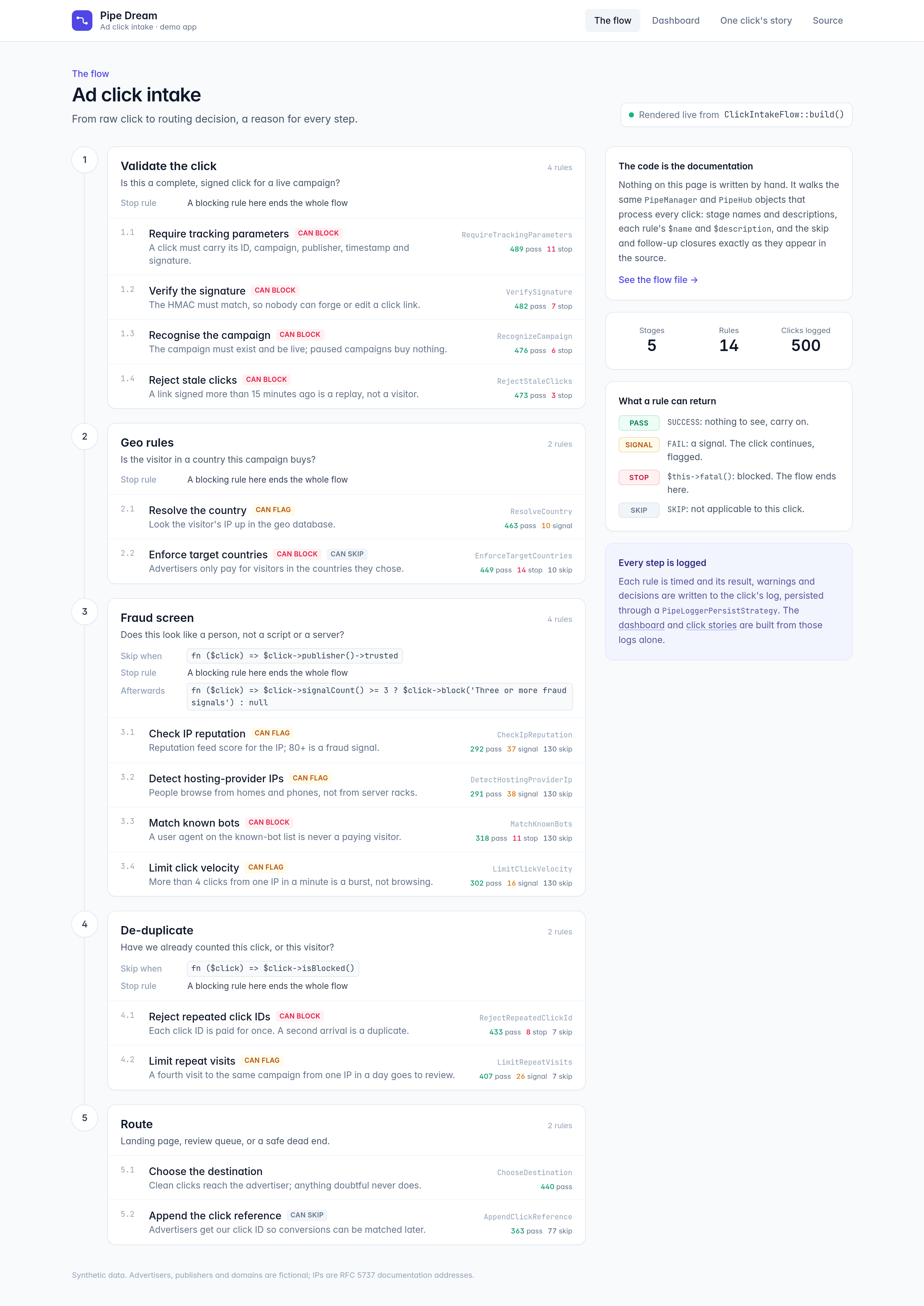
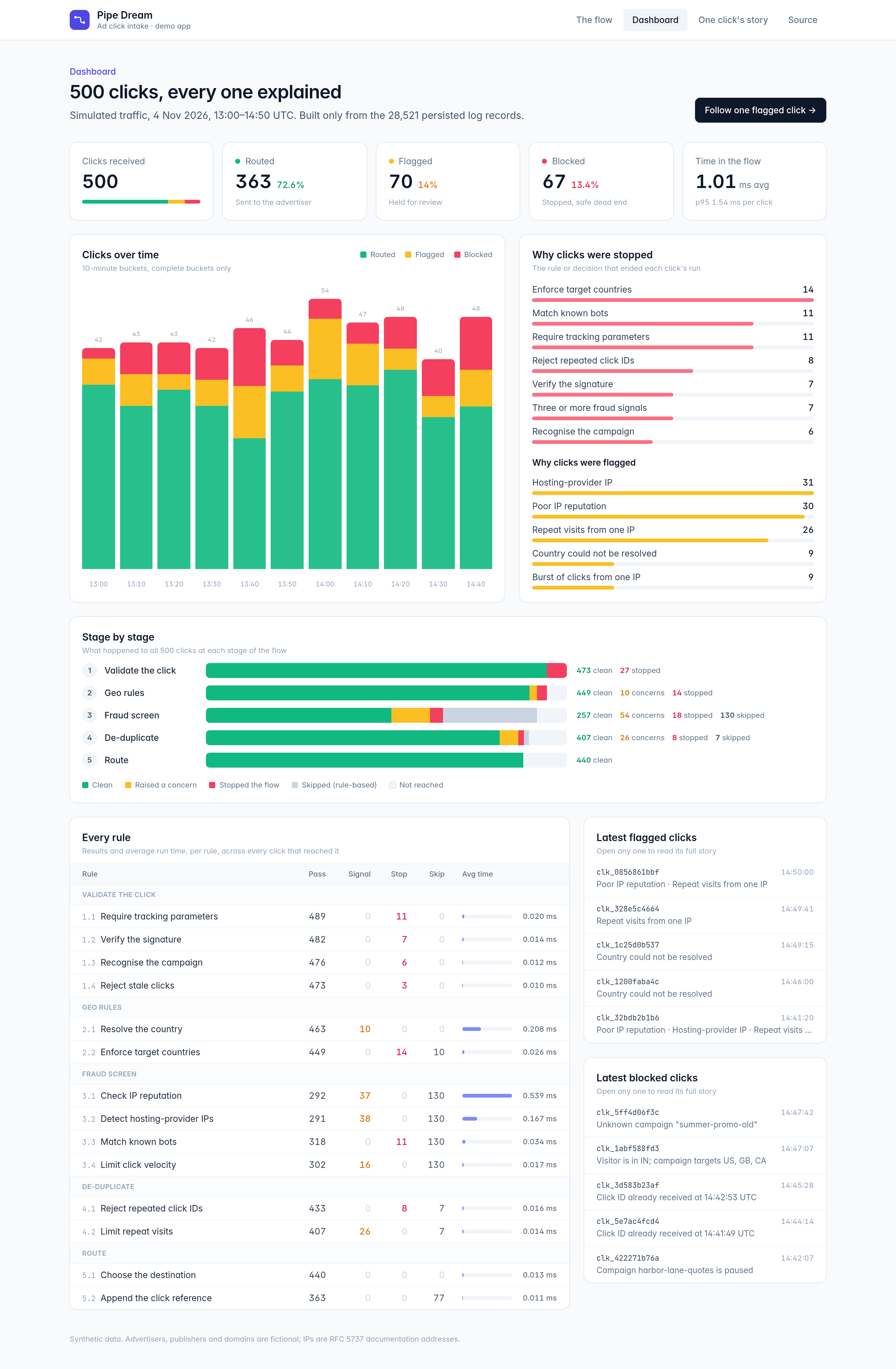
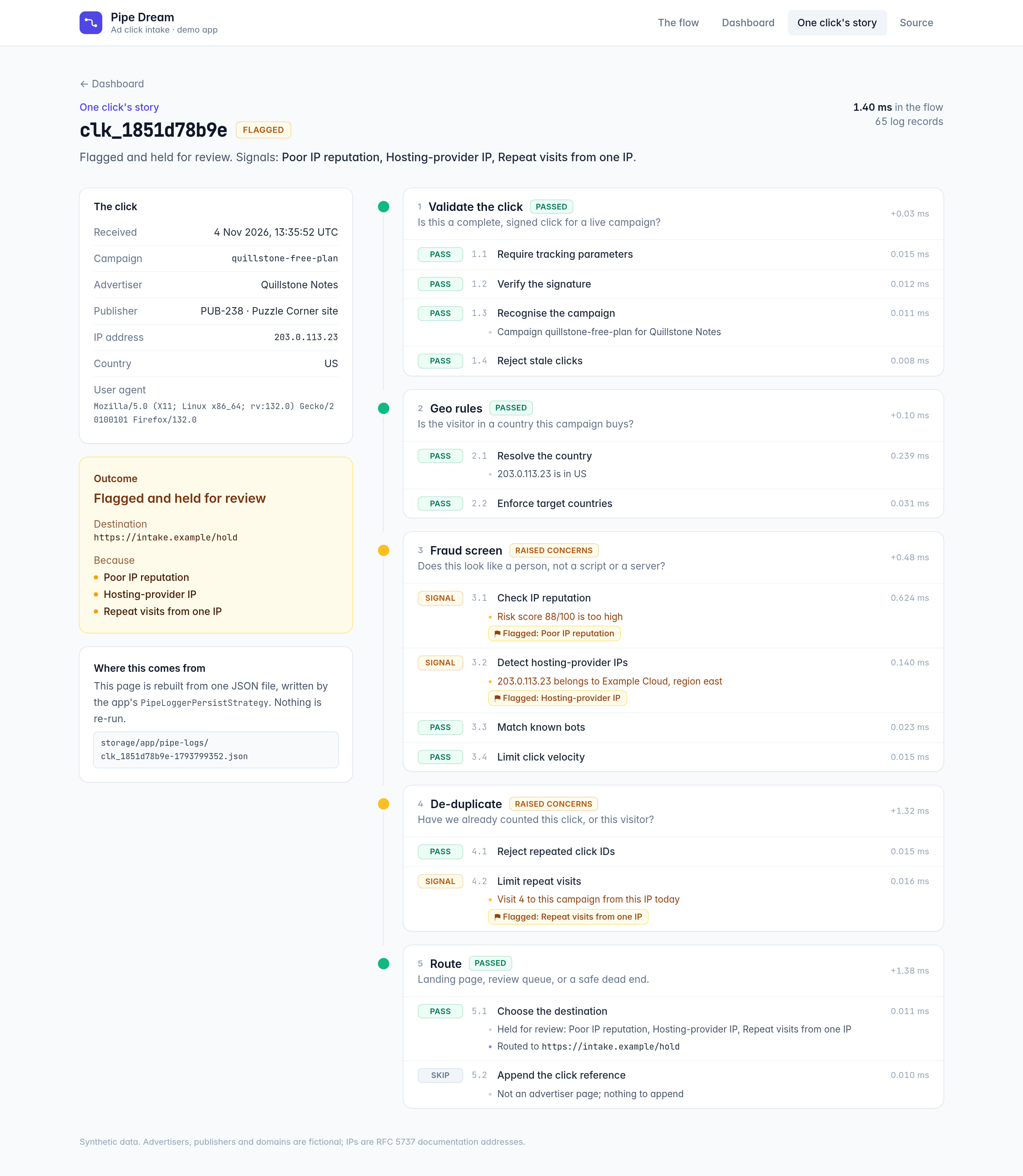
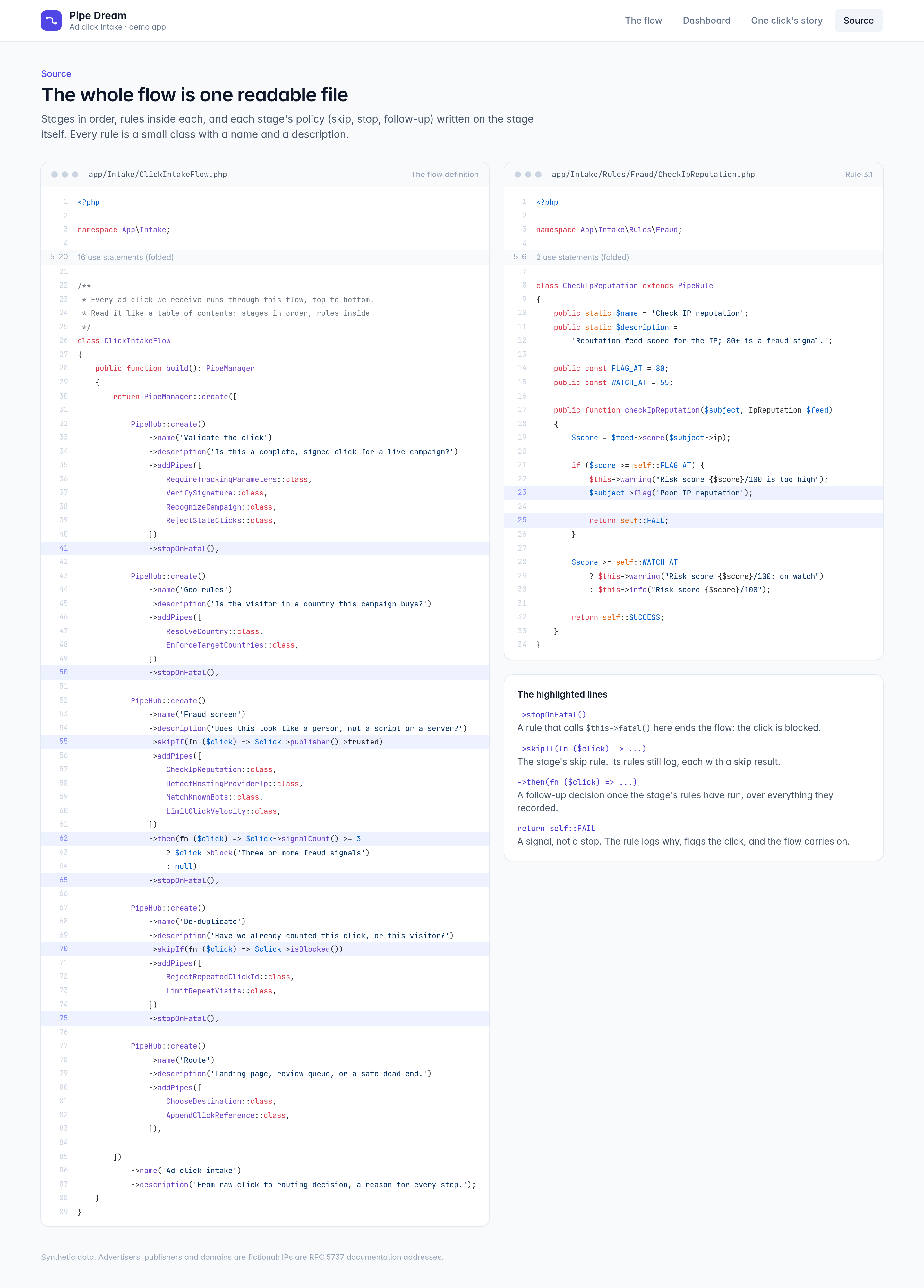
A demo app pushes 500 synthetic ad clicks through a five-stage, 14-rule flow like this one. Every page is built from the flow definition and the persisted logs, with nothing written by hand. The flow page is rendered from the code itself:
| Dashboard built from the logs | One click's full story | The whole flow is one readable file |
|---|---|---|
 |
 |
 |